What an Agenda Is Designed to Tell You
Learn how to read a public meeting agenda by following its headings, item order and supporting papers to find the purpose of each discussion.
You open a council agenda to find out why a road closure is being discussed, but the title gives you only a street name and an item number. Reading the agenda as a map of the meeting helps you locate the purpose, the papers and the likely route through the discussion without mistaking it for a record of what happened.
1. Read the front matter for the meeting’s boundaries
Start with the meeting name, date, venue and any note about the body holding it. A planning committee, school board and licensing panel may use similar words for different kinds of work. The body’s name tells you whose agenda you are reading; the date and meeting type help you avoid confusing it with a later revision or a different committee’s papers.
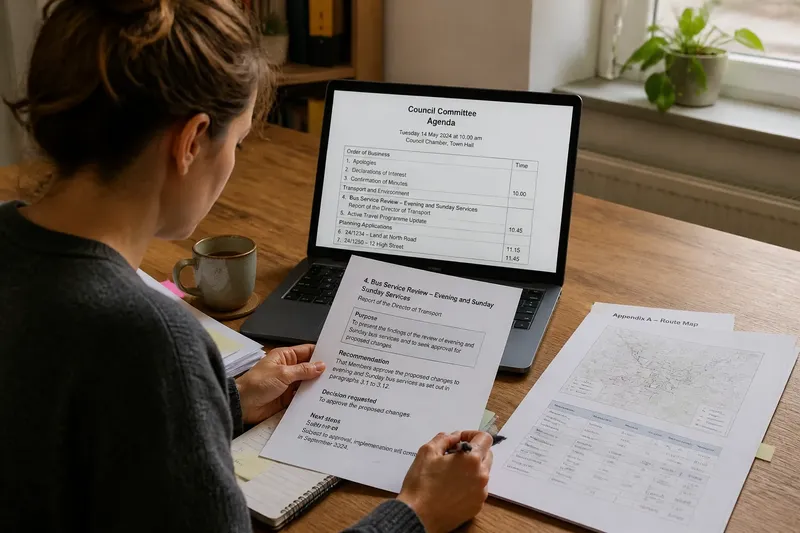
Look for opening headings such as apologies, declarations of interest or confirmation of earlier minutes. These are not the main subject items, but they show what the chair may need to address before the listed business. A note about public access, confidential business or document availability can also tell you which parts of the pack are open to readers and where supporting papers may be found.
Check the agenda’s page numbers and contents list before searching for a phrase. A long pack may place appendices after the agenda itself, and a link beside an item may lead to a separate report. The front matter gives you the boundaries of the document, not a promise that every page describes a discussion in full.
2. Treat headings as signposts, not explanations
Agenda headings group work into broad areas: for example, transport, finance or community services. They can help you scan quickly, but a heading often names a portfolio rather than the question the meeting will address. Follow the heading down to the numbered item and read the accompanying description before deciding what the item concerns.
Look closely at the wording. “Update”, “review”, “application” and “appointment” suggest different purposes, but none tells you on its own what members will do. A heading may identify a subject while the report explains whether the meeting is being asked to consider options, receive information or take an action. Keep the two levels distinct: the heading helps you find the item; the item’s details help you understand its intended role.
Say you are looking for a discussion of evening buses and see a heading called “Transport matters”. The numbered entry underneath names a service review and links to a report. That is a useful route to the relevant material; it still does not tell you what the members ultimately said or did.
3. Notice the order without reading it as a verdict
Items are arranged in an order that helps the meeting proceed. Routine business may come first, followed by reports, applications or other scheduled matters. The sequence can reveal what the agenda presents as the meeting’s route, and it can help you see which items precede another. It does not, by itself, explain why an item appears there or establish its importance to every reader.
Some agendas include a timed schedule. Treat those times as navigational aids, not as a record of when an item was actually reached. Meetings can take more or less time than planned, and an agenda may list business that is moved, deferred or not reached. If you need to know what happened, look for the appropriate record after the meeting rather than inferring an outcome from item order.
Scan for linked items, too. One report may provide background for another, or a later item may refer to an earlier recommendation. Note the connection, then read both entries or papers. The order gives you a clue about how the pack is arranged, not a complete explanation of the relationship.
4. Open the supporting paper to find the purpose
A short agenda entry often cannot carry the full explanation. Its attached report may set out the issue, background, options considered and the action requested from the meeting. Look for labels such as “purpose”, “recommendation”, “decision requested” or “next steps”. These sections are usually the quickest way to understand why the paper is on the agenda.
Read the requested action carefully. A paper may ask members to approve a proposal, note an update, choose between options or give officers direction. Those requests are not interchangeable. If the agenda entry is brief or uses internal shorthand, the paper can clarify what kind of consideration is intended, though it cannot tell you whether the request was accepted.
When an agenda links to several attachments, check which one is the main report and which are appendices. Maps, consultation summaries or draft policies may supply detail without stating the meeting’s purpose. Use the report to identify the question, then consult an appendix when you need the supporting material behind it.
5. Follow references and document labels
Public packs often refer to a report number, appendix letter or earlier item. Match those labels as you move between the agenda and its papers. A report title may differ slightly from the agenda wording, so the item number and document label can be more reliable guides than searching for an exact phrase.
Notice whether a paper is marked as an addendum, revised version or supplementary document. Such labels indicate that the pack contains material beyond the original agenda entry. Check the document date and version note before relying on a page you saved earlier; a later paper may change the information available to readers without changing the item’s short heading.
If a link is missing or an attachment will not open, use the contact details or document access route provided by the relevant public body. Ask for the paper by its meeting date, item number and title. Those details make the request easier to identify than a general reference to “the report”.
6. What can an agenda answer, and what remains open?
Can an agenda tell me what a meeting decided?
No. It sets out planned business and may identify an action requested, but it is not a record of the discussion or outcome. Check the meeting’s later record for what was agreed, amended, deferred or left unresolved.
Why does an item have only a short title?
The agenda may use a compact label to keep the list readable, while the accompanying report carries the detail. Open the linked paper and look for its purpose and requested action before drawing conclusions from the title alone.
What should I do if the supporting paper is absent?
Check the public body’s meeting page for an attachment or supplementary pack. If it is still unavailable, contact the listed meeting team with the date and item number, and ask where the paper can be accessed.
Use the agenda to choose your next document
Read an agenda in layers: identify the meeting, scan the headings, locate the numbered item, then open the paper that explains its purpose. That sequence turns a crowded pack into a practical set of directions. For a public meeting agenda, the most useful question is not simply “What is this about?” but “Which document tells me what the meeting is being asked to do?”
Keep a note of the item number and report title as you read. When you return later to check the meeting record, those details give you a clear starting point and help you compare the planned business with the record of what followed.