The Minutes Myth: A Record Is Not a Transcript
Understand what public meeting minutes can tell you, when to seek a recording or supporting document, and how to choose the right record for your question.
You open the council minutes hoping to find the exact words spoken about a planning application. Instead, you see a short note that the committee discussed the item and agreed to defer it. Public meeting minutes are not usually transcripts: they record selected information about the meeting, not every comment in order.
That distinction matters because the right document depends on what you need to know. Minutes may help establish what happened formally, while a recording, report or written submission may be better for another question. Treat the minutes as one part of a public record, not a complete account of the conversation.
Start with the question you need answered
Before searching, state your question in one sentence. Are you checking whether a decision was made, trying to identify the reason recorded for it, or looking for a particular speaker’s wording? Those questions call for different sources.
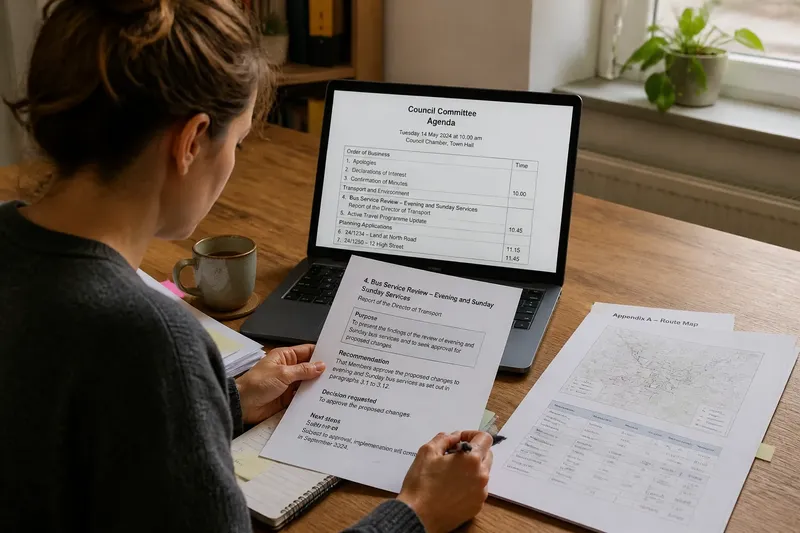
Minutes are commonly prepared as concise records. Their format varies by authority and meeting type, but they may include attendance, declarations of interest, motions, decisions, assigned actions and a brief account of discussion. They may not name every speaker or preserve each argument.
A transcript aims to capture spoken words in sequence. A recording lets you listen to what was said, though it may not have a written transcript. Neither format should be assumed to exist or to cover every part of a meeting. Check what the authority actually publishes.
Write down the issue, meeting date if known, and the detail you are trying to establish. That small distinction saves time when you search the document library.
Use minutes to confirm formal actions
If your question is whether a committee approved a motion, postponed an item or assigned a follow-up task, the minutes are often the sensible starting point. Look for the item heading and the wording used to record the outcome. A brief entry can be enough to establish the formal action without reproducing the debate that came before it.
Notice whether the record says a decision was made, a recommendation was issued, or further work was requested. These phrases describe different procedural outcomes. Do not infer a final decision from a summary of discussion alone.
Also check whether the minutes are marked as draft or approved. Draft minutes can be subject to later correction. An approval status tells you where the record sits in the meeting process, but it does not turn concise notes into a transcript.
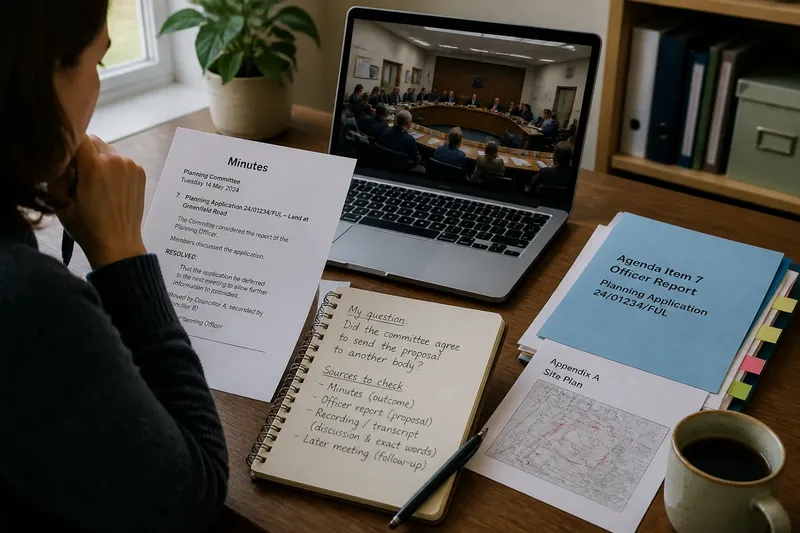
Say you need to know whether a local committee agreed to send a proposal to another body. The minutes state that it resolved to forward the proposal, while a longer report explains the proposal itself. For the question of what the committee formally did, the minutes fit; for the substance of the proposal, open the report.
Seek another source for exact wording or fuller reasoning
If you need to know precisely what a councillor said, whether a concern was raised in particular terms, or how a discussion unfolded, concise minutes may not answer you. Look for a meeting recording, published transcript or webcast archive. Search the authority’s meeting page and document library using the meeting name and item title.
A recording can provide context that a short record leaves out, such as the order of contributions or a clarification. It can also take time to search, especially if there is no transcript or item-level timestamp. If you find a transcript, check whether it is labelled verbatim, edited or otherwise summarised.
For the reasons behind a decision, read the officer report, committee paper or written recommendation alongside the minutes. These documents may explain the options considered, relevant policy and the advice presented to members. They show what was put before the meeting, not necessarily everything members said or the only reason each person held a view.
If a report cites appendices, maps or consultation material, follow those links before treating the summary as the whole picture. The supporting papers can clarify technical terms or show which evidence was available at the time.
Match the source to the situation
- You need the formal outcome: Start with approved minutes and locate the recorded resolution or action. Check a later meeting record if the item was deferred or returned.
- You need a speaker’s exact words: Search for a transcript or recording. Minutes may identify a speaker in some cases, but they are not a reliable source for a complete quotation.
- You need to understand the issue discussed: Read the meeting paper and its appendices, then use the minutes to see what action followed.
- You are checking whether a concern was raised: Look at the recording or transcript if available, and compare it with relevant written submissions. A missing point in the minutes does not establish that nobody raised it.
- You need to know what happens next: Check the minutes for an assigned action, then look for a later agenda, report or published update. A recorded task is not the same as evidence that it has been completed.
Keep the distinction clear: each source answers a different kind of question.
Read a concise entry without filling in gaps
Minutes compress discussion. A phrase such as “members discussed the report” does not reveal the full range of views, the strength of a concern or the precise sequence of comments. It records that discussion took place, not its complete content.
Do not treat silence in the minutes as proof that a topic never came up. Equally, do not use a broad summary to attribute a detailed position to a named participant unless the record supports that attribution. If the point matters, seek a source that preserves more of the exchange.
Separate three things as you read: what the minutes explicitly record, what another document says was presented, and what you are trying to infer. This prevents a report’s explanation from being mistaken for the committee’s recorded conclusion.
What should you look for when minutes are hard to find?
Where are public meeting minutes usually published?
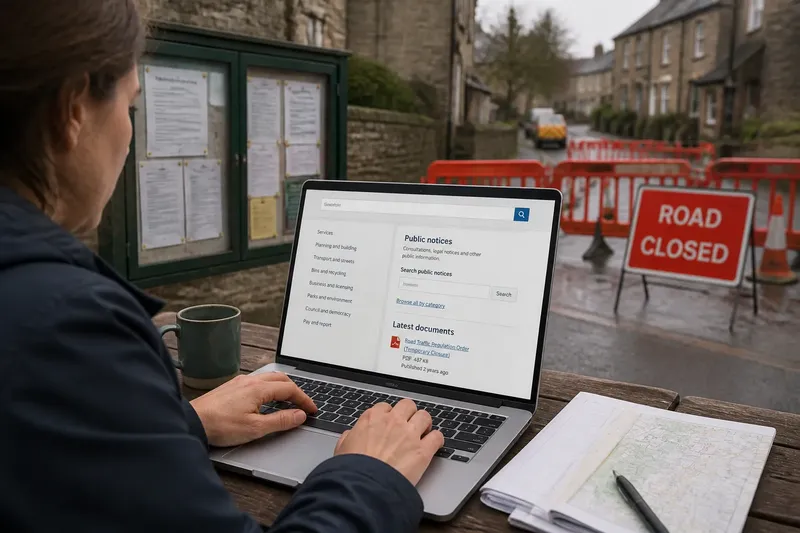
Start with the relevant authority’s meetings or committee pages, then search its document library by body name, meeting date or agenda item. Some pages place minutes beside the agenda and papers; others list them in a separate archive.
What does it mean if the minutes are marked as draft?
Draft minutes are a provisional record that may be considered for approval at a later meeting. Use them cautiously for formal wording, and check whether an approved version has since been published.
Can I quote minutes as proof of what someone said?
You can quote what the minutes themselves record, with the meeting and document identified. Do not present a concise summary as a word-for-word quotation from a speaker.
What if no recording or transcript is available?
Use the minutes for recorded actions and consult the meeting papers for background. If a specific detail remains unresolved, contact the authority’s information or committee team and ask whether another record is available.
Keep a clear trail when sharing what you found
When you pass on a finding, identify the source and describe its limits. For example, say that the approved minutes record a motion and outcome, rather than saying they reproduce the debate. Include the meeting name, date and item title so another reader can locate the same record.
If you use a recording or supporting paper as well, say which source supports each point. That makes it easier to distinguish formal action from background material and spoken discussion.
The useful habit is simple: match the source to the claim. Minutes are valuable for the formal record they provide; for exact words or fuller context, look for a record built to preserve those details.