Before You Attend: A Listening Plan for a Public Meeting
A listening plan for a public meeting helps you identify the subject, prepare useful questions and hear what remains unresolved without pressure.
You open a public meeting notice on your phone while the kettle boils. The subject sounds relevant, but the document is dense and you are not sure what you should listen for. A listening plan for a public meeting gives you a simple route in: identify the subject, prepare a few questions, then listen for what is still open.
You do not need to speak, know every technical term or follow every item on the agenda. The aim is to leave with a clearer account of what people discussed, what they did not settle and where you might look next.
Start with the meeting’s stated subject
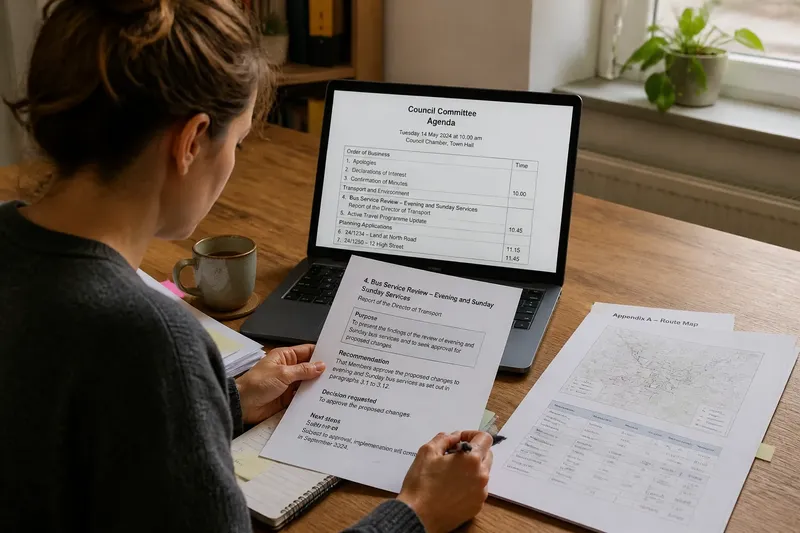
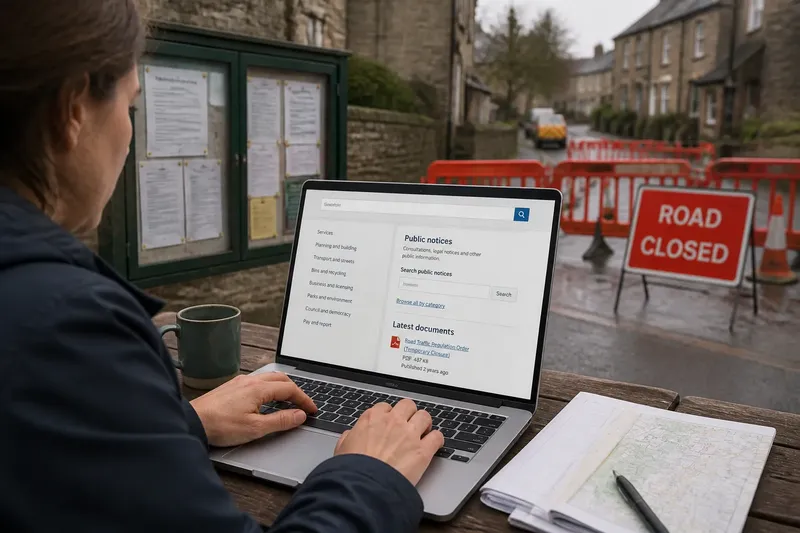
Find the meeting notice and agenda on the council or public body’s website. If the papers are available, open the report linked to the relevant agenda item. Begin with the item title, then read the short description or recommendation that appears with it. Treat these as signposts, not as a complete account of what will be said.
Write down the subject in plain language. Keep it narrow enough to guide your attention. “A proposal to change how the library entrance is used” is easier to listen for than “community facilities”. If the item covers several questions, note the one that matters most to you.
Look for who is bringing the item forward and what kind of discussion is planned. A department might be explaining a proposal, a committee might be considering options, or members might be invited to comment. These clues help you avoid expecting a final answer from a meeting whose purpose is to hear views or clarify details.
Do not try to read every attachment before deciding whether to attend. Scan the relevant report for its purpose, the issue under discussion and any points it says still need attention. If you find unfamiliar terms, jot them down rather than letting them stop you.
Make a small page of listening notes
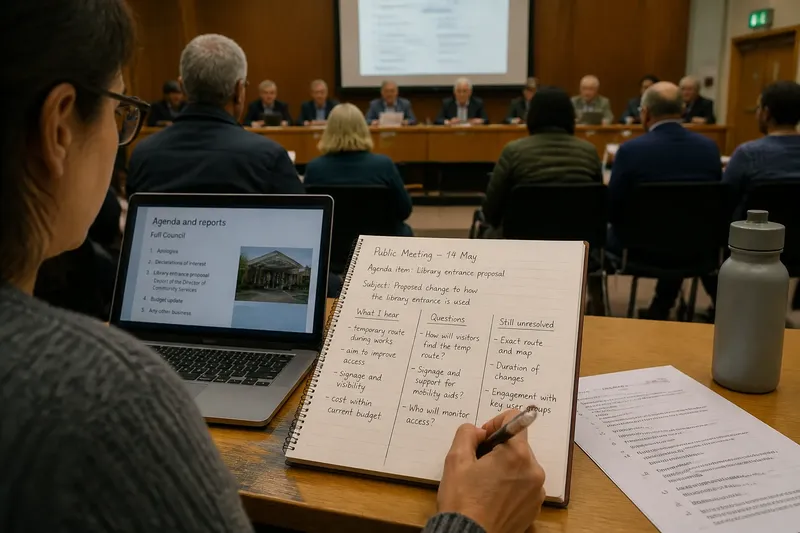
Use a notebook, a plain document or the notes app on your phone. Divide the page into three parts: “What I hear”, “Questions” and “Still unresolved”. Leave room under each heading. This keeps your notes focused without turning the meeting into a race to record every sentence.
At the top, add the meeting date, the name of the public body and the agenda item. Then copy your plain-language subject underneath. If you are attending online, keep the agenda open in another tab so you can check which item is being discussed.
- What I hear: note the main claims, options, concerns and reasons offered.
- Questions: record points you cannot yet explain or information you would need to understand the issue.
- Still unresolved: note what participants leave undecided, unclear or dependent on later work.
Use brief phrases, not full minutes. For example, record “access route questioned” rather than trying to reproduce a speaker’s entire contribution. Keep observation separate from interpretation: “staff say entrance remains open during works” is more useful than “access is solved”.
Prepare questions that help you listen
Before the meeting, write two or three questions you hope the discussion will answer. They do not have to be questions you plan to ask aloud. Their job is to give your attention a direction.
Useful questions often ask what a proposal changes, what reasons support it, whose experience has been considered, or what information is still missing. Try to make each one specific to the item. “How might the entrance change affect people who use mobility aids?” is more directed than “Is this a good plan?”
Say you are following a proposed change to a library entrance. You might note that the papers mention a temporary route but do not describe how visitors will find it. At the meeting, listen for who explains the route, whether signage is discussed and whether anyone asks for more detail. Your notes can show whether the question was answered, partly answered or left open.
If your question concerns a personal situation, keep it factual and decide in advance whether you want to raise it. You can listen without speaking. If you do want to contribute, check the meeting’s published arrangements for public questions or comments. Procedures differ, and some meetings do not include a public speaking period.
Arrive with room to settle in
Check the location or joining details before the meeting day. For an in-person meeting, note the building entrance and room shown in the notice. For an online meeting, check the joining link and any instructions for identifying yourself or using the chat. Labels and participation rules can vary, so follow the public body’s own instructions.
Give yourself a little time to find the room, settle your papers and locate the agenda item. If you arrive after discussion has started, listen for the current item rather than trying to reconstruct everything you missed. You can check the agenda later for context.
Choose a seat or screen position that makes it easy to hear and refer to your notes. You may also want a pen, water and a copy of the agenda. Keep the setup simple; the important preparation is knowing what you want to follow.
Before proceedings begin, write one reminder at the top of your page: “Listen for what is explained and what remains open.” This helps if several speakers move quickly between details.
Listen for reasons, questions and gaps
When the item begins, first listen for the issue being framed. Does the speaker describe the same subject you prepared for? Has the focus shifted to a related point? Add a short note if the discussion takes a turn that changes what you need to understand.
As people speak, listen for the connection between a claim and its reason. A speaker may describe a problem, offer an option and explain why it is preferred. Record those pieces separately where possible. This makes it easier to tell the difference between a stated concern and a response to that concern.
Notice questions that receive a direct answer, questions that receive only part of an answer and questions that are set aside. A response may explain the general approach without resolving a specific detail. Mark the distinction plainly; an incomplete answer is still useful information about what needs follow-up.
Listen for language that signals uncertainty or future work, such as a matter being referred for further consideration or details to be brought back later. You do not need to infer a hidden outcome. Write down the words used, who is expected to act if that is clear, and whether a next point of contact is mentioned.
Also note when speakers disagree about the problem itself. One person may describe a change as improving access while another questions who benefits. You can capture both positions without deciding during the meeting which account is right.
What should you do if the discussion moves too quickly?
Should you try to write down every speaker?
No. Keep only the point that helps answer your prepared questions or shows what remains unresolved. A short note about the reason given is usually more useful than a record of every contribution.
What if you lose track of the agenda item?
Check the agenda or wait for the chair to identify the next item. Mark the point where you lost the thread, then resume listening without filling your notes with guesses.
Can you attend without speaking?
Yes. Listening is a valid way to take part in a public meeting. You can prepare questions for your own understanding and decide later whether any need to be raised through an available public channel.
What if a term is unfamiliar?
Write it down as heard and note the sentence around it. The surrounding discussion may make its meaning clearer, and you can check the term in the meeting papers or ask the relevant public body afterwards.
Sort your notes before you leave
At the end of the item, take a moment to mark each prepared question as answered, partly answered or unanswered. Add a few words showing what you heard. This gives you a clear record without pretending the discussion resolved more than it did.
Then list what remains open. Separate an unanswered question from a future action: “route details not explained” describes a gap, while “officers to provide route details” records a stated next step. If nobody names an action or timing, do not supply one yourself.
Imagine that, in the library discussion, the meeting explains where the temporary entrance will be but leaves signage undecided. Your notes might say: “Route location explained; signage plan not settled; no next date given.” That gives you a grounded account and points to a specific question you could follow up.
If you plan to contact the public body, keep the message brief. Name the agenda item, describe the remaining question and ask where further information will be published or who can respond. Avoid sending a long account of every speaker unless the body asks for it.
Keep the listening plan useful after the meeting
Store the notes with the agenda or report, so you can see which document they refer to. If a later paper appears, compare it with the open questions you recorded. Look for whether the issue was addressed, whether the explanation changed and whether a further action was described.
You may also decide that no follow-up is needed. A meeting can clarify enough for you to understand the discussion, even when it does not settle every detail. The point is not to pursue every unanswered question; it is to distinguish what you heard from what you still need to know.
A listening plan for a public meeting works best when it stays small: one subject in plain language, a few questions and a clear place to record what remains unresolved. Keep that page beside the agenda, and you will have a more useful account to take away, whether you speak or simply listen.