Proposal, Recommendation or Decision: Three Different Stages
Proposal, recommendation or decision can signal different civic stages; learn to check a document’s status and wording before treating an idea as settled.

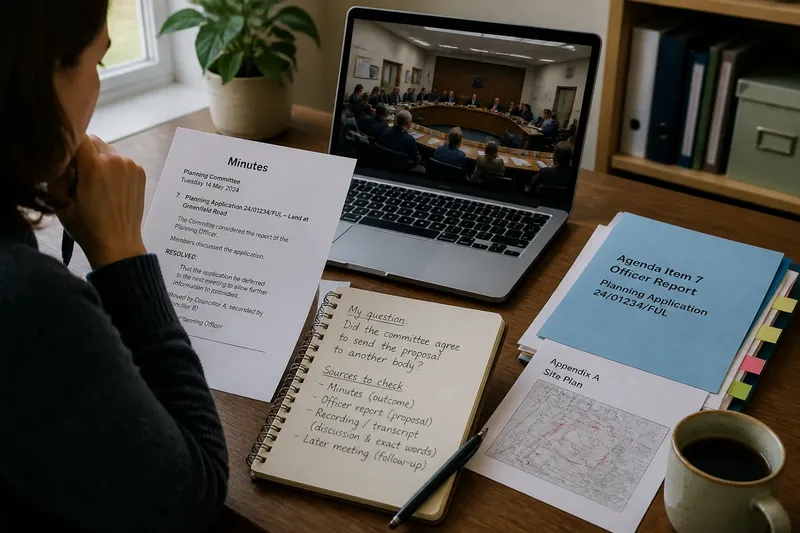
At the kitchen table, Maya opens a council paper and sees the phrase “recommended for approval” beside a plan to change the hours at a neighbourhood library. A friend has already shared the news as if the new hours were settled. But proposal, recommendation or decision can signal different stages, and the paper’s status matters as much as the headline.
Imagine a wholly invented situation: a fictional borough is considering whether to open its library later on one evening each week. The path from an idea to an official outcome gives Maya a useful way to read the language without guessing what the council has done.
A proposal puts an idea into consideration
The first paper describes a proposal: a suggested course of action that someone wants the relevant body to consider. It might come from council officers, a committee member, a community group or another source named in the document. The word signals that an option is being put forward; by itself, it does not say that the option has been approved.
In the fictional borough, an officer’s paper proposes opening the library later on Thursdays. It gives a reason for considering the change and asks the committee to examine it. Maya checks the front page for the document type, author, date and any status label. She also reads the section that states what the committee is being asked to do.
That request could be to discuss the proposal, seek views, request further work or make a recommendation. Those are not interchangeable actions. If the paper asks members to “consider” an option, that wording does not itself show that they are being asked to adopt it.
A proposal may also describe several options rather than one settled plan. Look for phrases such as “one option is”, “proposed change” or “subject to consultation”. Such wording points to an issue still under consideration. Read the surrounding paragraphs before treating a short heading as the whole account.
A recommendation points towards a preferred option
Later, a committee report recommends that the borough approve the Thursday opening change. A recommendation is advice or a proposed course of action put to whoever has authority to decide. It can be strong advice, but it remains distinct from the decision unless the document says the recommendation has been adopted by the authorised body.
Maya checks who is making the recommendation and who is meant to act on it. The report may recommend that a committee send its view to a cabinet, council or other decision-making body. The committee’s recommendation and the later body’s decision would then be separate stages. The names and roles vary across public organisations, so the paper’s own wording is the best guide to its route.
She also reads for conditions. The recommendation might depend on further consultation, a revised plan or another approval. A sentence that sounds decisive in isolation can be qualified by a condition elsewhere in the report. The recommendation section, proposed resolution and any listed next steps help show what is actually being put forward.
In the invented case, the committee recommends approval but does not have final authority. Maya can accurately tell her friend that the committee has backed the proposal and that a further decision is due. She should not say that the new hours have been confirmed.
A decision records an authorised outcome
At a later meeting, the body with authority considers the report and approves the change, subject to a stated condition. The resulting record identifies the outcome. This is the point at which the source document can support the claim that a decision has been made, within the scope and conditions it records.
Maya looks for the formal decision wording, such as “resolved”, “approved” or “the committee decided”. She checks the name of the deciding body, the date and the exact action. A decision might approve only part of a proposal, defer the matter, reject it or send it back for more work. The presence of a decision does not mean every detail in the original proposal was accepted.
In this invented situation, the final record approves later Thursday opening, but only after a further operational review. The careful account is that the change was approved subject to that review. Saying simply “the library will open later” would omit a condition that may affect what happens next.
For a quick reading, follow the document’s own verbs: what is proposed, what is recommended, and what has been resolved? Then match each verb to the body and status stated in the source.
Read the status alongside the wording
Words alone do not establish where a matter stands. A heading may call a paper “Decision”, while its status says “draft”; a report may contain recommendations but be marked “for information”. Check the document’s status or publication label, then read the relevant passage in context. If the source identifies a later decision record, use that record to confirm the outcome rather than relying on an earlier paper.
Keep the claim narrow. If a report says a proposal is recommended for approval, describe it as a recommendation. If a record says an authorised body approved a named action, describe that decision and retain any conditions. If the source says the matter is deferred, do not translate that into approval or rejection.
Where the organisation’s decision route is unclear, look for a named responsible body or a stated next step in its own documents. The route can differ between organisations and types of issue. Do not infer authority simply from the seniority of a speaker or the formality of a paper.
What do proposal, recommendation and decision mean?
Does a proposal mean the plan is approved?
No. A proposal is an idea or action put forward for consideration. Check the paper to see what body is being asked to do with it.
Can a recommendation be binding?
The word alone does not tell you that. Look for the body’s authority, the decision wording and any conditions or later approval required.
How can I tell whether a decision is final?
Find the record of the authorised body’s action and read any conditions, deferrals or further steps it names. If the document calls itself a draft or says approval is still required, the outcome may not yet be settled.
What should I do if two public documents use different terms?
Compare their dates, status labels, authors and stated actions. An earlier proposal and a later decision can use different wording because they record different stages; use the latest relevant official record to describe the current position.
Report the stage without overstating it
When Maya replies to her friend, she says the committee recommended the Thursday change and that the authorised body later approved it subject to a review. Each part of her account is tied to a specific document and action. That small distinction prevents a suggested plan from being mistaken for an outcome.
Use the same discipline when sharing public information: name the stage, keep the source’s conditions, and avoid turning a recommendation into a decision. For proposal, recommendation or decision, the document’s stated status and wording provide the soundest basis for saying where the issue stands.